Brain Destruction Ahead
Notes from a life inside the attention economy

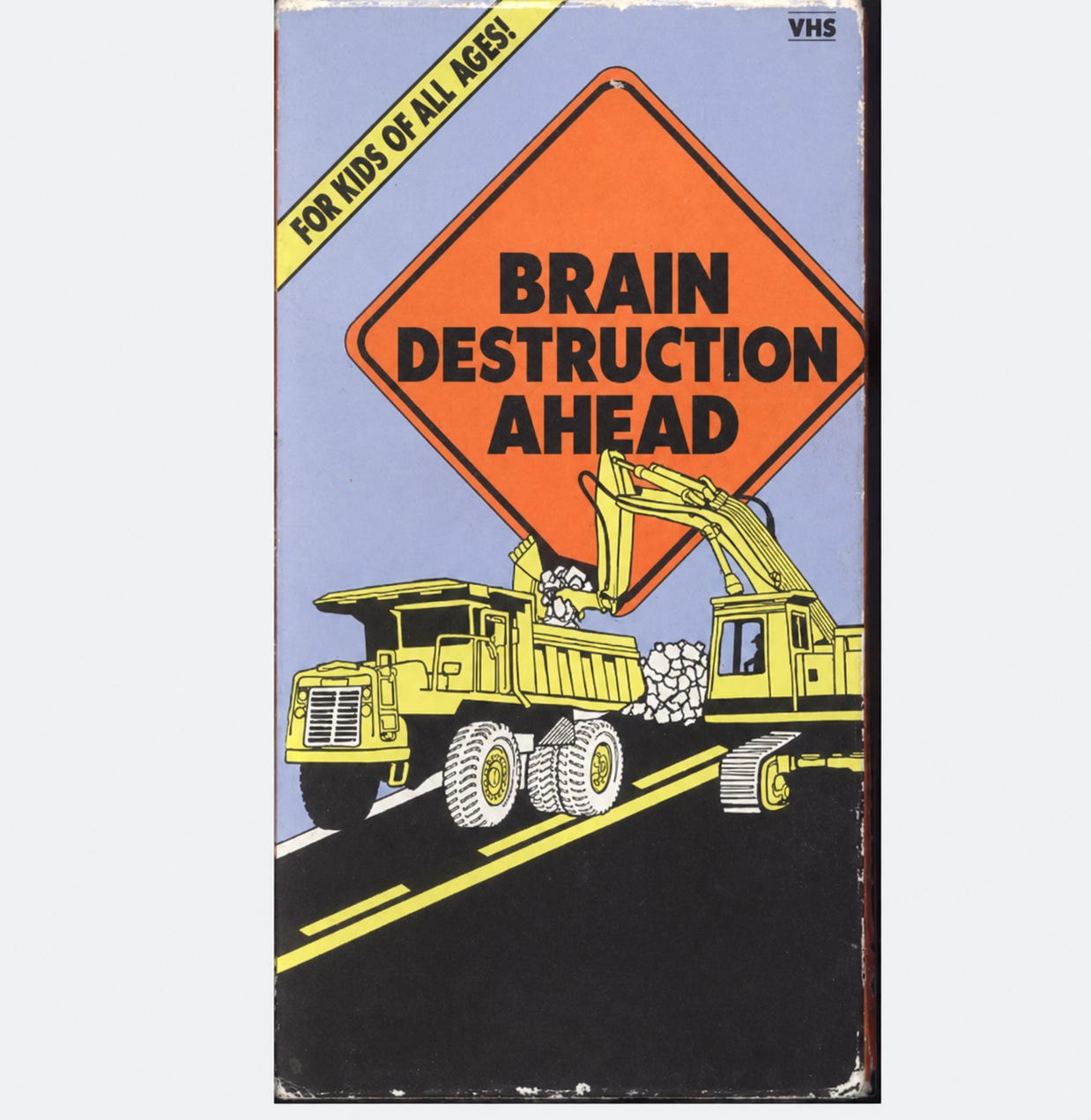
I- How to build a road
One of my earliest memories is watching a video called “Road Construction Ahead.”
Produced by a children’s educational company called Little Hard Hats in 1991, it showcases in impressive detail the steps of building a road. They spend a surprising amount of time showing the unsexy work of surveying: mustached men setting up tripods and just looking at the landscapes where roads might go one day.
My favorite section was watching these landscapes get blown up with dynamite. After a Michael Bay-worthy amount of explosion footage over cheesy 80s synths, the narrator says “Hey kids, wanna have some fun? Watch this!” Then, the entire sequence plays in reverse, dust and rubble flying improbably back together over an even cheesier synth section.
The video ends with a mom asking her two children if they want to go see the new road. They both put down their toys and gleefully and earnestly answer: “Yeah!”
While I suspect this tape was originally purchased for my brother, who had a well-documented boyhood love of backhoes, Road Construction Ahead quickly became one of my favorite videos to rewatch.
Back then, choosing what to watch was one of the few powers I had. As the youngest of three siblings, much of the family system and rules felt set in stone by the time I arrived. What was for dinner and where my dad brought us camping were not debatable. But I often got to pick out a VHS tape, if only to placate me for the tantrums I threw about everything else.
If my dad thought Road Construction Ahead would turn me into an engineer, it sadly did not work. What it did do was turn me into a ravenous consumer of media, teaching me that to be entertained is to be happy and to be entertaining is to be powerful.
It also taught me the kind of meta-lesson that all parenting is about: even the most entertaining video eventually ends.
They all end.
That is, until they don’t.
II- Salsa cookies, windmill cookies
I remember a high school birthday party at my friend Olivia’s house.
At one point, we ran out of things to do, so people started sharing their favorite YouTube videos. That’s when I was baptized in the millennial internet video canon: baby panda sneeze, dramatic chipmunk, charlie bit my finger, world record trampoline jump, Jenga tower world record accident, and the immortal Numa Numa guy.
Shortly after that, I got an iPod touch for my birthday, the first iPod that could get online.
As I lay in bed one summer night, unable to sleep, I remembered a funny video that my friend Mason had just showed me called “Oh Four Tuna,” a parody of “O Fortuna” from Carmina Burana. I wanted to rewatch it. Until this moment, wanting to watch something had required getting out of bed and turning on my PC, or going downstairs to the TV.
I’d never watched a YouTube video in bed before.
The experience felt exhilarating, pornographic, like I was breaking the law.
I opened Safari, pulled up YouTube, and giggled as a choir screamed:
“SALSA COOKIES! WINDMILL COOKIES! THEY’LL GIVE YOU GONORRHEA!”
I fell asleep with a smile on my face, thinking:
I can watch videos in bed on my iPod!? The future is now!
III- The bottom of the barrel
It’s a Tuesday night and I’m puttering about, cleaning the kitchen yet again while listening to the kind of grimly detailed World War Two podcast my dad might enjoy. Now in my mid-thirties, I can’t tell if I understand the male loneliness crisis because I’ve listened to so many goddamn podcasts about it or because I’m beginning to quietly live it.
Here I am, home alone again.
My men’s group, the “no book book club,” started our monthly meetings a year ago by discussing Derek Thompson’s “The Antisocial Century” in The Atlantic. Over chili we nodded and agreed that phones are a poor substitute for social connection. Now, this group, like affordable grocery prices and optimism, appears to be on hiatus for the foreseeable future. Not because it wasn’t fun or meaningful—just entropy: busy adult men with wives, lives, jobs, kids.
I go on Instagram to feel connected, distracted, anything.
Behold: someone is on vacation! Trump is lying. My brother and cousin are both at glamorous destination weddings. Mangled bodies lie beneath rubble in Gaza. Thirty-seven minutes pass on the main feed and now I am in a lightly furious fugue state.
Besides a few memes I dutifully send to the correct group chats, nothing here pleases me so I head to reels.
Here, at first it’s better:
Tanner’s tips for hitting a better third-shot-drop in pickleball, Satirical recreations of married couples arguments, isn’t it funny the way British people sound sometimes?
Then things get more acidic, paranoid, and angry.
Here are 5 things I regret from my visit to Phuket. Have you ever considered that the American economy is set up to work only for the super wealthy? You have to know these tips or you will be human trafficked the next time you stay in a hotel.
Then, with one more swipe, I enter the Twilight Zone:
A fifteen-foot tiger shark eats a Russian tourist alive off the coast of Egypt. An impossibly curvy OnlyFans model looks up at the camera seductively. A cliff diver becomes paralyzed after mistiming a jump, then an insect lodged in someone’s ear, then more paralysis content.
Seemingly everyone on Instagram reels is paralyzed or about to be paralyzed. This and underwater cave diving accidents are the morbid topics Instagram loves to trawl up at night.
By the time I close my phone over an hour has passed. I could not tell you half of what I watched, nor why I watched it. I’d both chosen and not chosen to watch any of it. It sort of just happened.
I came into this wanting to feel connected, relaxed, and distracted. Now I feel sad, angry, and sick.
IV- Nobody asked for this
I never planned to spend so much time watching Reels. I never wanted to be on Instagram at all. I was fine with MySpace.
But I signed up for Facebook during my junior year of high school because it’s what the cool kids were doing. Facebook offered a cleaner, more adult way to stay in touch with our friends after school.
I remember the buzz when they unveiled the news feed. Why would we want to get random updates about what our friends were doing?
Ew.
People created groups and petitions asking Facebook to get rid of it. They did not listen.
While I didn’t really get Facebook in high school, it all clicked in college. All my friends were on there and we’d take turns poking each other, writing inside jokes on each other’s walls, and posting photo albums of our epic nights out.
After graduating, I lingered on Facebook because it helped me stay in touch with my friends now scattered across the country.
But over time I noticed that my friends were posting less and less.
My feed went from close friends to acquaintances and random people I barely knew. It felt like a mall that once contained my entire social life had been slowly but imperceptibly changed to one full of cranky elderly strangers, one person and post at a time, ship of Theseus style.
That’s when Liz entered my comments.
She was the mom of a middle school friend who I hadn’t seen in years.
Sometime during 2020, I started getting into heated political arguments with her.
She’d comment on everything I posted with drive-by contrarian arguments tailor-made to extinguish my fervor. We clashed compulsively, ritualistically, two halves of the same reflex. As my feed served me Ibram X. Kendi and Ta-Nehisi Coates, hers gave her Candace Owens and Ben Shapiro.
When I tried to provide sources or encourage her to take a more nuanced view on race, she would mention this tennis camp she’d worked at. She’d argue that because Arthur Ashe wanted kids of all races to be able to play tennis, race didn’t matter. No matter what I said, she’d respond with the tennis camp. For her, that tennis camp was load-bearing.
After she quoted MLK out of context for the seventh time I blocked her and stopped checking my Facebook.
During the run up to the election it had gotten too stressful and alienating, so I packed up my things and moved to Instagram. I hoped for peace, quiet, and periodic photos of my friends’ sandwiches.
But Instagram now felt a lot more like Facebook.
I logged on daily looking for my friends, but the people who posted most were old co-workers, random acquaintances, influencers, and brands. The feed made me hyper-aware of the people I cared about least.
I, in turn, posted about my life less and less. The timing never felt right. Sharing photos of a dinner party felt awkward while Ukraine was being bombed; wedding dance floor videos would feel gauche while Gaza burned. I told myself it was the news cycle but eventually realized I was terrified of how I’d be perceived. The same crowd whose approval I was starving for was the one I couldn’t bear to be judged by. Posting only life highlights would be vain and dishonest. Posting about my sadness or grievances would be self-pitying and tone-deaf. Nobody wanted another angry political take. So I slowly stopped posting altogether.
Meanwhile, Instagram kept retrofitting the app to bolt on clones of, and features from, other apps I never asked to use: Snapchat via stories that disappeared after 24 hours, and Reels, Facebook’s defiant declaration that “we have TikTok at home.”
At every turn, I kept looking for my friends, but the further I ventured into the forest to find them, the more I encountered everything but my friends.
From age sixteen to thirty-five, Facebook kept changing their apps in ways I didn’t like, and I kept not leaving. Each redesign was annoying but survivable, which, in hindsight, was their entire business model. They were training us, gently, to accept that the product would keep getting worse for us and better for them — and that we’d stay through all of it.
V- Breaking bad
I know more people who have a healthy relationship to cigarettes than to Instagram.
Alexis has quit dozens of times since we started dating. Most people I know have quit and come back multiple times, have quit for good, or are begrudgingly on there, as I was, “just for the memes.”
What pushed me to take three full months off this winter was realizing just how much it was polluting my headspace.
This happened, of all places, on the way to a wellness retreat.
After encountering flight delays at SFO, instead of talking to Alexis, reading my book, or watching YouTube videos about how the fall of Constantinople affected LeBron James’s legacy, I found myself on a reel spiral watching increasingly disturbing videos about Jeffrey Epstein and his sadistic island.
After liking one reel condemning the many horrific things that man did, the algorithm had evidently decided that this was my new obsession and it was all too happy to indulge and/or create that obsession for me. That’s how I spent over an hour inhaling truly upsetting content about child abuse, sex trafficking, and cannibalism.
I wish I could say this experience was an aberration, but spirals like this were becoming common for me as I tasked Instagram with filling every trip to the bathroom and coffee break.
Something odd happens if you spend enough time interacting with the Instagram algorithm. The glowing illusion of it being a basket of delights harvested just for you lasts for about twenty minutes. Once the sure-to-please content is exhausted, you could and should leave, but you crave more and it wants to placate that, so it starts upping the temperature on everything. As you grow numb and it grows desperate, it begins to shovel out a nauseating slurry of the most titillating and upsetting aspects of human experience, delivered in thirty-second increments.
After enough time, Instagram will always revert to different forms of porn: travel porn, outrage porn, wealth porn, political porn, accident porn, war porn, health porn, death porn, regular porn.
Logging off felt like the only option to escape all this.
It felt good enough that I kept adding on weeks until a month, then months, had passed.
Stepping away felt satisfying but oddly anti-climactic as a form of dissent, like silencing my voice right when it should be loudest. It brought to mind the Mitch Hedberg quote: “I’m against picketing, but I don’t know how to show it.”
It didn’t add anything distinctly positive to my days. It merely took away the chaotic possibilities presented by intermittently spinning the roulette wheel of psychological arousal.
I even discovered a new species of loneliness: the feeling that my life was generating less reality than other people’s, that Reilly without public documentation was somehow less meaningful. Without Instagram, I could no longer hide behind the synthetic sense of narrative momentum it provided and had to sit with the fact that I don’t always know whether my life is meaningful or on the right track. In my mid-thirties, when everyone I know seems to be arriving at wildly different destinations while I’m still mid-transit, this hit harder than I expected.
Taking a break from one addictive app hasn’t fixed all my problems.
The reality is that I still feel lonely, bored, sad, and like I don’t want to be doing my job sometimes.
Now I just have to sit with these feelings instead of dissociating via endless scroll, confronting what I was really hungry for when I kept logging on.
It wasn’t the videos — I could find better ones on YouTube. It was to feel connected, to feel like I belonged, to feel like I mattered.
A good evening these days feels like this:
We come home from the gym sore, energized, and proud. I dance about the kitchen to make dinner as an episode of Diabolical Lies plays. We eat my latest incarnation of a global rice bowl and banter about our weeks before migrating to the couch to watch The Summer I Turned Pretty. Yes, I have strong opinions about this, too, but they are for another essay. Alexis lights candles and I feel like there’s nowhere else I need to be or anything else I should be paying attention to. After brushing our teeth, we read our books for twenty minutes: she’s reading a new fairy smut novel and I’m on Yesteryear. Once we’re too tired to read, I put on a YouTube deep dive into a historically bad NFL franchise, unpacking their comical mismanagement, which puts Alexis to sleep within minutes. Then I shut off the video and close my eyes to join her.
VI- Everything is awful, everything is television
I went to high school and college during the “golden age” of Facebook.
Back then, the warning signs were hard to see. Things were changing too fast to properly monetize. They hadn’t turned it into an extractive data engine yet, hadn’t tweaked the algorithm to optimize for outrage, hadn’t yet wondered if something this powerful might be used to facilitate genocide.
We have fewer delusions today.
Accelerating this unmasking is that all social media has mutated into what appears to be its final form: short-form video.
As ever-abundant Derek Thompson put it: “Everything Is Television.”
The recipe for keeping people on your app so you can continue showing them ads and harvesting their data is finding a way to serve them as many hyper-palatable short-form videos as humanly possible.
So everyone has dropped any pretense of doing otherwise.
This is why all podcasts are video podcasts now. It’s why Meta successfully argued in court that they’re not a social media company because most people that use their apps don’t use them to talk to friends, but rather to mainline short-form videos from strangers. It’s why the New York Times of all places is pushing short-form video on me with all the self-awareness of Microsoft Clippy.
Influencers now pay thousands of “clip farmers” overseas to edit down their videos into even shorter clips that are more likely to go viral.
And so the trough gets filled ever higher with short videos and shorter clips of these videos: bold, engaging, chemically perfect slop.
In hindsight, Covid was the point of no return.
Before Covid, the real world was the primary space and social media the auxiliary one. The pandemic accelerated a reversal already under way. We retreated online because our apartments were depressing and the world outside was dangerous. We told ourselves this was temporary. It wasn’t. The hierarchy has flipped for good. The real world is now merely raw material for the online one — something to capture, edit, and upload. Content has become reality, and mastering reality requires mastering content.
The lesson I'd absorbed from a VHS tape turned out to scale nationally. The president got into power the way influencers do — by mastering attention itself, a game built on recognizing that it’s better to be outrageous than right, better to be quotable than coherent, better to be publicly incendiary than privately virtuous. I can’t tell whether I see this clearly because I’m perceptive or because I was trained the same way he was.
VII- Under the influence
By the time I understood how much this system was taking from me, I was already helping feed it. I’ve spent the past decade working in content marketing, chasing the dragon of virality.
When I arrived at Imperfect Produce at 26, I naively thought that good, earnest communication was enough to succeed in marketing. I was swiftly schooled on what it took to capture the spotlight. To work creating this content is harsher than consuming it. You are constantly reminded that your work isn’t engaging enough and constantly told you have to adapt to a new algorithm and start using new features.
The peak of my powers and belief in this system came in my late twenties, when I had a podcast, better hair, and more optimism than I do now. After being told we had to do daily Instagram stories, I spent over a year making delightful educational videos about fruits and vegetables full of songs and raps that I wrote about produce. They were packed with pop culture references, little easter eggs, and outtakes full of laughter at the end.
For a while, people loved it. They loved me. I saved my favorite comments in a Google doc called “nice things and warm fuzzies” to soothe my ego when people said my voice was annoying or they thought my tip for cutting pomegranates was bullshit.
But my time as an ugly-produce influencer was short-lived.
Instagram stories were eventually overtaken by reels and the algorithm shifted away from branded content entirely. Our engagement tanked. Even though I knew it wasn’t my fault, it still felt like a referendum on me.
Even when I had weeks of great metrics and glowing comments, I never felt secure.
Back then, even the victories felt fragile. Constantly dancing for online approval was exhausting and increasingly antithetical to how I wanted to spend my time and what I actually believed.
The costs began to feel visceral. Having the entire internet connected to my amygdala via the comments section felt less sustainable by the second.
In that world, I could only be successful if I gave everything I had, all of the time.
VIII- The limit does not exist
In college a YouTube video introduced me to David Harvey, who blew my mind with this sociological bar: “Capital cannot abide a limit. It has to turn it into a barrier which it circumvents or transcends.”
I first learned what this looked like during the Great Recession. In between dancing my ass off to recession pop, I’d find myself asking family members and college professors what exactly had happened to the US economy. No amount of confident mansplaining by NPR’s Kai Rysdal could make it make sense.
The truth was simpler and sadder than the adults made it seem: lending to people who could actually repay was leaving money on the table. So banks started writing mortgages they knew would default, bundling them, and selling them to someone else before the bill came due. It was a game of hot potato that was profitable until it wasn’t.
Then this same logic came to gambling. Gambling used to be something you had to travel to Las Vegas or Atlantic City to do. Going to a few places to bet on card games was deemed an insufficient amount of gambling, so companies like FanDuel and DraftKings spent years and millions of dollars lobbying to legalize sports betting nationwide. Now that gambling has been untethered from cards and slot machines, it is possible to gamble from your phone in over half of US states.
But why limit your betting to sports when you could also bet on whether Trump would take a sip of water during the State of the Union or whether the US will bomb Iran? The assumption underneath the boom in prediction markets like Kalshi or Polymarket is that every American should be gambling on everything, constantly.
The short-form video arms race is just another incarnation of this principle.
Mark Zuckerberg rebranded his entire company and burned somewhere north of 70 billion dollars on his now-shuttered Metaverse. The initiative failed, but the assumption underneath it endured. This assumption is now shared by nearly everyone in Silicon Valley: spending six hours a day on screens will never be enough when there are eighteen more to capture.
It’s like they all watched WALL-E and came to the conclusion that the cute robot was actually the villain because he prevented the Buy N Large corporation from delivering their customers more sodas and videos to their floating armchairs.
The last thing I want in my life is more screen time and that’s increasingly all anyone assumes I want.
Everyone I know is exhausted. We are all drowning in political fundraising texts, spammy robocalls, unread group chats, and three different apps buzzing to remind us we haven’t opened them in a while. Ever since I left Instagram they’ve started emailing me to remind me that people have posted new stories, like even their notifications have notifications now. Every time I visit LinkedIn I see an urgent wall of red dots but nearly all of them are for updates as inane as “someone at Salesforce sneezed recently.”
The dream of nearly everyone I know is simply to be left the hell alone and this is the one thing these companies cannot allow. To them, every friend of mine deleting the app, every break I’ve taken, every evening I’ve spent with my phone in another room — these are not neutral acts of self-care. They are churn. They are the precise behavior entire teams of professionals exist to detect and reverse. I know this because I’ve worked with teams like these. I’ve written their copy. My peace is their lost revenue. So the quieter we get, the louder they shout. They don’t give a shit that we’re tired. Tired is the goal. Tired people scroll constantly.
IX- You know people said radio would kill our attention spans too, right?
Right now, somewhere on LinkedIn, perhaps aware that an essay like mine doesn’t yet have a counterargument, a self-assured man’s fingers are already flying across a keyboard in a frenzied flurry: “Tech backlash is overblown. Since the printing press, people have been saying new media would ruin the kids’ attention spans. The novel, newspapers, radio, and TV didn’t bring about Armageddon so you need to shut up, stop being such a Luddite, and accept the march of historical progress.”
The real distinction is always in the business model. Newspapers and magazines need you to buy a copy, preferably a subscription. Radio needs you to listen long enough to hear ads. Instagram needs you to stay on platform as long as humanly possible. That’s not a difference of degree; it’s a difference of kind. When the product is the consumer, the design has to be optimized to prevent you from leaving. The tell is that now even the subscription services, the ones that already have your money, still fight for every minute of your day. When asked what Netflix’s primary competition was, CEO Reed Hastings didn’t name another streaming service. He said one word: “sleep.”
Modern algorithmic media is bidirectional in a way nothing else is. These apps watch you, learn what you like and what you fear, and adjust to exploit your psychology in real-time. Teen girls are handed more reasons to hate their bodies. Lonely men in their thirties are handed more proof that everyone else is connected. Boomers are handed more evidence that the country has gone to hell. Calling this just another media innovation like the printing press or radio is both lazy and inaccurate. It’s a categorically different type of experience, much closer to visiting a casino than reading a novel or even watching TV. Yet even Las Vegas casinos cannot adjust their layouts to become harder for you specifically to leave once you sit down at the slot machine. The economics of every previous era of media were built around selling content or access to audiences. Social media sells the audience itself, continuously optimized for maximum extractability. That’s not a new chapter in the same story. It’s a different story.
This profoundly misunderstands the real Luddites. Industry constantly re-writes history in its favor. The auto industry created the term jaywalking to blame pedestrians for car accidents. The term litterbug was coined by an alliance of can and bottle manufacturers and Coca-Cola to shift blame for waste from the companies creating the packaging to the individuals now tasked with recycling it. The most brazen example was BP hiring ad agency Ogilvy and Mather to invent the term “carbon footprint” so you and I could be blamed for climate change instead of corporations. Yet Luddite is the proto-example of all of this. The real Luddites didn’t reject tech wholesale. They were protesting the low-pay and child-labor seen in English textile mills. That this real history has been deliberately erased should tell you everything you need to know about why people actually critique new tech: not because of the tech itself but the exploitative power structures it embodies and replicates.
Comparing social media to TV or radio is a rhetorical smoke bomb disguised as debate. It redirects the argument away from the specific, documented harms of this technology, right now, toward a vague referendum on whether people have always had concerns about new media. They have. That’s not the question. And when you label any skepticism as reactionary hysteria, the industry never has to defend its addictive products and extractive business model on the merits — suddenly it’s the critic who has to prove harm. As many women know too well, making concern look like hysteria is a deliberate, bad faith tactic to shut down harder conversations.
Opting out is available in theory but punishing in practice. Contrarians love the argument that’s really a dare: if you don’t like it here, just leave. As if the only thing at stake is FOMO. But the apps are where the traffic is, so professionals and creatives are told they have to promote themselves there to get ahead. It’s not enough for me to write fun Substack articles anymore. I should really make them into videos, then clip them into shorter videos, then cross-post them to Reels, X, Bluesky, and TikTok.
And even if you never promote yourself on these apps, you may not escape their orbit. Nearly all the highest-paying jobs where I live are at the ominously named FAANG companies: Facebook (now Meta), Apple, Amazon, Netflix, and Google. These are some of the last jobs around here that pay enough to make buying a house or having a kid feel remotely possible. Whatever else they sell, they’re all in the same business: becoming the infrastructure you can’t actually opt out of — the phone, the feed, the search, the cloud, the screen. You can loathe their business models and still rely on their products. You can see exactly what they truly value and still need a paycheck from one of them.
X- Gone in an instant
Being aware of these mechanisms does not free any of us from them. These titanic companies define the region I live in, the fluctuations of the stock market, and the texture of our democracy, society, and reality.
They present such thorny problems that they make me pine for the previous generation of evil corporations. When Frito-Lay changes their products, Cheetos get cheesier, yes, but it doesn’t change what your neighbor believes is true. When Ford releases their latest truck, you may object to the design or gas mileage, but at least it doesn’t impact how lonely your children feel.
My generation and those after us have been experimented on and distorted in ways we can and can’t name, but we’re not going to know for sure what the results were until years or decades later.
When I watched Road Construction Ahead as a kid, the video would end after twenty-eight minutes. If I wanted to watch it again I’d have to rewind the tape. If I wanted to watch something else, I’d have to get off the couch, go to the shelf, and choose between our well-worn VHSs of Beauty and the Beast and Aladdin.
Today’s children experience something more akin to the girl from The Ring emerging from the TV and hitting play on another video for them. Except the experience is so curated and automated that it feels delightful instead of horrific, which is the most horrific thing about it.
Coda- Hey kids, wanna have some fun?
The first thing I remember wanting to be when I grew up was a movie director. Videos brought me so much joy that I wanted to make this joy my life and share it with other people.
When surveyed, over half of Gen Z said they want to be influencers. Gen Alpha’s top aspiration is to be a content creator. Young people get undeserved hate for many things, particularly the type of media they engage with. While I do wonder if there are enough influencing, YouTube, and TikTok jobs to go around, I do not find this ring-lit bunch’s aspirations surprising, much less something to judge or scorn.
Young people are perceptive.
Young people are adaptable.
They notice what is present, what is absent, and what is rewarded.
Like an entire generation of lonely youngest children, they believe, as I did, that their best path to success, relevance, and survival is just four words:
Demand attention. Be entertaining.
It’s why my favorite scene of Road Construction Ahead, the only part with any editorial savvy, stuck with me. As a kid, watching rubble fly back into hillsides felt like magic. As an adult, I see it as a sleight of hand — one that sold me the lie most modern media is built on: that destruction is fun and reversible, that I could have spectacle without consequence.
Now, surveying everything that’s been demolished to make way for the new road to our brighter tomorrow, I’m struck by how little of it can be undone.
As a kid, I thought the dream was for the fun to never end. Now it doesn’t. We stare and giggle late into the night, entertained past the point of pleasure. The fantasy wasn't a frictionless world full of entertainment. It was believing you could build an expressway to this world without leaving everything else in rubble.