Devilish Good Looks
The Devil Wears Prada 2 is the sequel we deserve

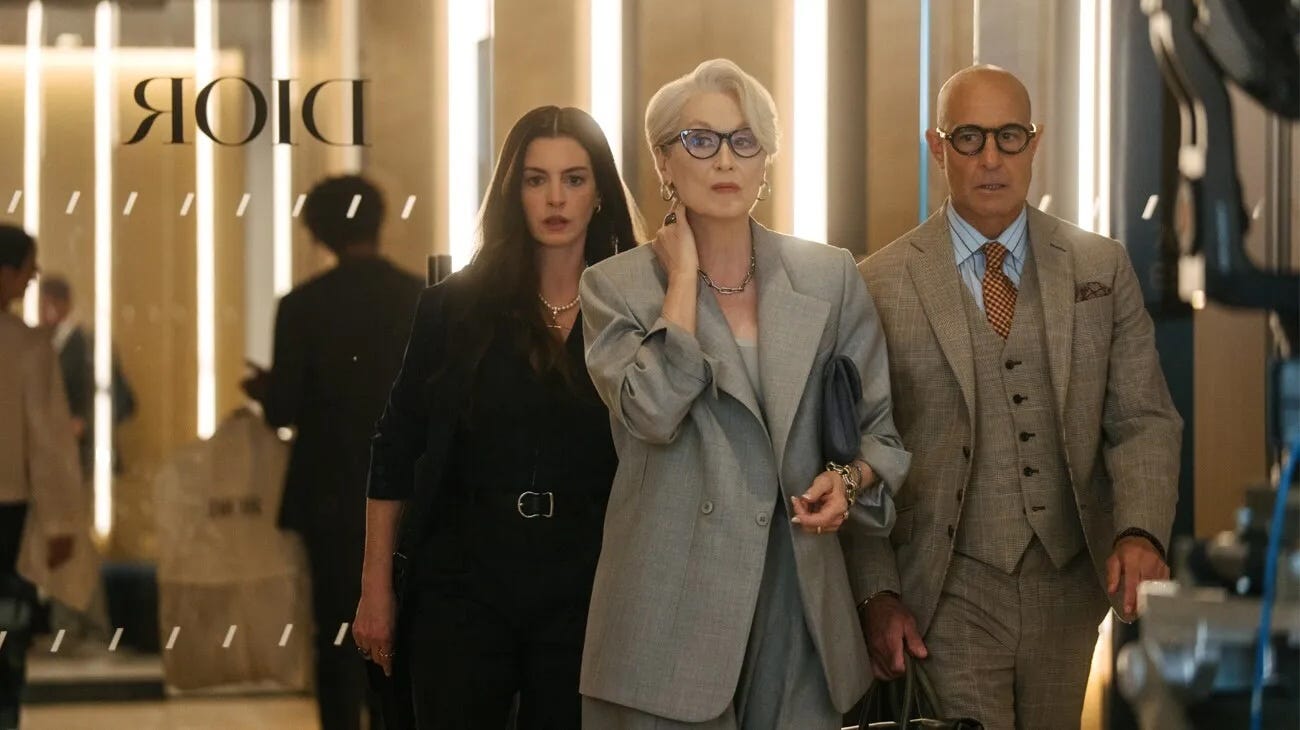
To be alive and online today is to be immersed in an endless discourse on death.
You’re constantly, exhaustingly informed about the death of journalism, the middle class, reading, writing, expertise, our attention spans, and the American dream.
Movie theaters have been declared dead half a dozen times just since I graduated college, the killer definitively identified ad nauseum like a game of Clue.
It was streaming/COVID/Marvel, that killed you, in the board room, with private equity!
So imagine my surprise when I saw a line of people at AMC Bay Street in Emeryville, bottle necked like ships stuck outside of the Strait of Hormuz.
I’d been coming to this theater for twenty years and had never seen a line, much less one this long.
By my estimation, nearly everyone was there to see the same movie I was: The Devil Wears Prada 2.
The one thing still uniting modern America is that we just have to see how Miranda Priestly and Andy Sachs will run a fashion magazine when magazines, journalism, and the American attention span have all been legally declared dead.
Two hours later I had my answer.
The Devil Wears Prada 2 is an unnecessary sequel that neither fails nor does anything worth remembering. It’s not bad, but since it doesn’t attempt much more than indulging our nostalgia and fan service, it’s hard to call it good.
It’s a disposable, of-its-moment form of wish fulfillment that’s as safe as it is stylish.
That it’s already outgrossed the original tells you everything you need to know about what we’re all wishing for right now.
In a world where The Met Gala resembles The Hunger Games more and more each year, derivative movies are what we reach for when reality gets too loud.
Like Legally Blonde or Mean Girls, The Devil Wears Prada was ahead of its time— misunderstood as a makeover chick flick only to be later reclaimed and embraced by a broader audience. Thanks to its razor sharp screenplay and great performances, it’s now endlessly quoted, discussed, and debated. There are even video essays defending Miranda Priestly and declaring it “Scorsese for Women.”
The Devil Wears Prada has endured because its a perfectly-paced, evocative journey into a toxic workplace. It’s a fashion movie in the same way Whiplash is a drumming movie.
Like Whiplash, what it’s really about is ambition, greatness, and confronting what you have to sacrifice and who you have to become in order to rise to the top of a cutthroat industry. It’s also a movie about the insanity that is modern work. We seldom get movies about predominantly female workplaces, so it’s remarkable to get one this fascinating, bouncy, and fun.
None of this works without the nuance and ambiguity in the character of Miranda Priestly. Unlike the book it was adapted from, which portrayed Miranda as a purely evil taskmaster as a literary middle finger to Vogue editor-in-chief Anna Wintour, movie Miranda is a much more subtle antagonist.
Yes, she is a demanding perfectionist, but we later learn these qualities are essential to thriving in this field. As Andy herself points out, if she were a man all everyone would say is that she’s good at her job.
We don’t need to be told this. Streep’s iconic performance deftly shows it. She based many of her acting choices on powerful men she knew. Priestly’s signature quiet vocal register was based on how Clint Eastwood runs a movie set.
When Miranda dismisses someone’s idea, she can always back up why. Even when she is dressing people down, she’s working while she does it. She evocatively embodies what it means to have sophisticated taste.
While the audience surrogate character of Andy (like the average male viewer) arrives skeptical of fashion, viewing it as unserious and frivolous, the movie does admirable work to take fashion seriously, showing us both why it matters and what it truly costs. Some of the film’s best scenes like the Cerulean monologue and Nigel’s heart to heart with Andy are those that show us the blindspots in Andy’s self-righteous but naive world view.
It’s a painful process, but Andy undeniably matures from working under Miranda, growing from under-qualified and entitled to a competent professional who is willing to stand up for who and what she believes in. Miranda is an effective antagonist because she forces Andy to make hard choices that reveal who or what she truly values.
The original isn’t perfect. It’s surprisingly fat-phobic and both of Andy’s love interests are problematic in different ways. Yet despite these blemishes, the masterful acting combined with the zippy screenplay and stylish cinematography make it rewatchable and beloved.
Even if you earnestly believe the original warranted a sequel, making another Devil Wears Prada movie was always going to be a hard needle to thread.
The first movie was both a prescient take on the Faustian bargain of work in America and a snapshot of the golden age of magazine publishing.
Interestingly, it’s the warnings about work that have aged the best and simultaneously become the least fun to revisit. Since 2006, the idea of a job that bulldozes work-life balance has gone from cautionary tale to dominant norm. Miranda Priestly is no longer a villain specific to the rarefied world of high fashion. She’s your manager at a software company, texting you on Sunday because the company just did another round of layoffs but still needs to hit its numbers.
As the Miranda model of “total-work” has eclipsed more humane alternatives, the publishing industry has experienced multiple extinction events thanks to the rise of social media and the exodus of advertisers.
The Devil Wears Prada 2 wisely recognizes that it must confront this mess somehow.
The plot openly embraces the death of journalism, the rise of online clickbait and outrage cycles, and the hegemony of billionaires.
Right as I felt the exhaustion of realizing there’s nowhere left to hide from these forces— not even in a Devil Wears Prada sequel — Andy Sachs dove into a monologue lamenting everything around her being gobbled up and sold for parts.
Amen, Andy.
Like the movie she inhabits, she’s asking a very 2026 question:
What could possibly save us from algorithmic brain rot and the billionaire private equity consolidation orgy?
What bothered me wasn’t that this question is a total bummer. It’s that in 119 minutes we get stunning outfits, pretty places, and famous faces, but nothing resembling a satisfying answer.
We hear Andy deliver overtures about sweatshops, gentrification, and high-fashion pricing out normal people one minute. We see Miranda flying coach the next. Then everyone hops into a private car, zooms off to a huge vacation house in The Hamptons, and meets up in a palatial hotel suite in Milan.
Even grand existential questions are just another cute outfit to pose in before moving on to something more glamorous and fun.
This movie is as easily distracted and in denial as the rest of us.
The second half of this film felt as indulgent as a Marvel movie except instead of a big fight scene or car chase we have glamorous people strutting across Milanese plazas and cruising across Lake Como on boats. Stanley Tucci equips Anne Hathaway in the most daring looks necessary for her weekend excursion to the Hamptons with the precision of Q outfitting James Bond before he parachutes in behind enemy lines.
While it’s initially thrilling to reassemble the sartorial Avengers from the first film, that enthusiasm cools as rapidly as microwaved leftovers.
Many of the beloved characters from the original film are flattened in this new installment.
Hathaway’s Andy has reverted back to her film one self: insecure and desperate for her boss’s approval. This undercuts all the growth we saw previously and is further weighed down by a gratuitous romantic subplot with an Australian realtor whose name I cannot recall.
While Andy has regressed back to film one, Streep’s Miranda appears to have forgotten that movie even occurred, arriving as a flat caricature of herself. She reverts to scorning Andy again, but the dialogue lacks the bite and sparkle of the iconic Cerulean monologue. We don’t get to see her human side as we did with the divorce subplot of film one, nor her strategic side, like when she outmaneuvered a rival and betrayed an ally in one slick Chess move.
The only person undiminished in this Runway saga is Nigel, played by the fine vintage that is Stanley Tucci. His performance and his arc were the most satisfying for me, mainly because Miranda and the film finally gave his character his flowers.
Where the first film forced its protagonists to make hard choices, this one merely moves them around between glamorous settings until the plot just sort of figures itself out over some phone calls and Aperol spritzes.
A movie that opens with a full-throated lament about the death of journalism ends at a Lake Como mansion charming a billionaire over lunch to save our fashionable little corner of it.
When Emily double crosses Andy, it should land like Miranda betraying Nigel in the first movie, but the film trivializes the choice and it becomes as meaningless as everything else. Andy undoes it by just charming a different billionaire.
Beneath the glitzy exterior is a shoddy and empty story, more fast-fashion than couture.
Andy never makes any decisions that pay off the burgeoning class consciousness in her dialogue. Miranda never passes the torch or reckons with her legacy. The only thing about Nigel that changes is the color of his pocket squares.
While the first film was packed with quotable lines and memorable scenes, by the time I walked out of the theater I had already forgotten most of this one, except for that dress Anne Hathaway wore to the Hamptons that looked like it was designed by MC Escher after hyperfixating on the old Microsoft Windows logo.
Yet as strongly as I feel all of this, I still bought my ticket, got in that line, and traveled to Milan with everyone else.
Sequels like this tend to come bedazzled with cutesy self-aware moments.
Sometimes these are clever, like the sweater vest Andy wears at the conclusion being a modified version of the Cerulean sweater from the first film. Other times they land with the subtlety of all of the celebrity cameos.
Did we really need Kara Swisher AND Lady Gaga in this?
Then there are moments of you just staring at the screen wondering how none of the main cast have visibly aged in 20 years.
The cameos, callbacks, and the re-play of “Vogue” by Madonna start to feel more desperate the more they accumulate, like the movie keeps breaking the fourth wall by saying “Do you like our new Devil Wears Prada sequel? We spared no expense.”
Like so many artifacts of this current era of media, this is an undeniably palatable and shittier version of something we all liked from years ago, repackaged and resold, destined to be buried beneath ten louder, more outrageous short-form videos by the morning.
The crowded screening and its dominance at the box office reveal one thing clearly. What Americans are craving more than anything is a consequence-free romp. We want to feel draped in nostalgia the way Lady Gaga was draped in meat at the Met Gala.
We want a movie that’s simultaneously bold and familiar, one that dares to say “if we’re all going straight to hell, we might as well wear the Gabriela Hearst Niki Patchwork Embroidered Maxi Dress in Aurora Multi Linen on the ferry ride there.”
Sure, it costs $7,900, but that’s still much cheaper than a house.
A truly good Devil Wears Prada sequel, one that actually asked our characters to take risks, lose things, and upset each other, would have been far too stressful for the kind of year most of us are having.
You can see this clearly in the state of the box office, where this movie’s only rival is a sanitized Michael Jackson biopic that trims out all of the controversy from his life so we can listen to his top-streamed Spotify songs guilt-free over an AI summary of his Wikipedia page.
Did you really want to reckon with reality right now?
Everybody wants this.