Squad Goals
A history of my 20s in 3 World Cups

"We didn't realize we were making memories, we just knew we were having fun."
-Winnie The Pooh
2010- South Africa
Nothing captures the feeling of being twenty like the frenetic tumbling of the drums that kick off “Wavin’ Flag” by K’NAAN.
It’s a narcotic surge of optimism that transports me back to college with the full body whoosh of the food critic’s childhood flashback in Ratatouille.
The saccharine pull of this song makes far more sense when you realize it was commissioned by Coca-Cola. Behold what happens when a soda conglomerate takes a hopeful anthem about making it out of civil unrest in Somalia, strips out all of the political lyrics, and amps the production to eleven. The result is a song that feels lab-engineered to make you believe.
This World Cup, like my early twenties, is an embarrassment of riches musically. In addition to “Wavin’ Flag” and its many remixes (my favorite is “Bandera de Libertad”), we are graced with the immortal banger, “Waka Waka” by Shakira. It doesn’t occur to me that music or summers like this will ever stop coming.
At twenty, privilege, hope, and hedonism all blur together. The World Cup feels built for us: a collective permission slip to feel everything as intensely as possible, loudly, and together.
My high school friends and I are all home for the summer after sophomore year of college, united by a shared understanding that our days are for three things: eating, drinking, and watching soccer. That’s why we’re all at Brandon’s parents’ house in Sea Cliff for the Spain–Netherlands final, crowded around the TV even though the third floor looks straight out at the Golden Gate Bridge.
The room is buzzing because whichever team wins today will be a team that has never won before. Mateo’s mom is Spanish, so he’s pulling for Spain. No one else is rooting for them mainly because of how they play.
The Spaniards have made it this far through Tiki-Taka, a possession-oriented style of soccer that’s either hypnotic or boring, depending on who you ask. It’s effective but anemic football, reliably producing exactly one goal a game. At this age, I have the subtlety of a vuvuzela, so I prefer the aggression of Germany, the chaos of Uruguay, and the physicality of the Netherlands.
I’m desperately hoping that the final gives us more than one goal when suddenly a bong appears, enormous and ceremonial. At this stage of my life, many events—whether improved by marijuana or not—involve an astounding amount of marijuana.
As the bong rotates with the efficiency of the Spanish passing game, I become suddenly anxious about missing the kickoff so Mateo pauses the game. I am dumbstruck at how he can pause live sports. It takes a few moments of stoned befuddlement to realize that Brandon has pre-recorded the game for us.
When the game unpauses, the stakes feel as high as we all are.
I feel anxious about who is going to win, even though I’m not sure who I want to win. At kickoff I settled on the Netherlands, because my grandpa Pete is part Dutch. Yet by the breathless, scoreless minutes of extra time, this feels like a flimsy foundation for a moment this big.
When Iniesta finally wins the game for Spain and pulls off his jersey to reveal a tribute to his dead friend, I wish I could say I feel the weight of history happening in real time.
Mostly, I just feel stoned.
Later, I call my college girlfriend Kaitlin and try to describe how I’ve been spending most of my summer to her but the words elude me.
“I’ve been watching a lot of soccer,” I start, before trailing off. I don’t think she will understand, mainly because I don’t think I understand.
2014- Brazil
Change comes fast and the mighty fall hard.
In the group stage, Spain is walloped by the Netherlands and then again by Chile—history settling a few scores at once. Their six-year dynasty evaporates in a week.
Meanwhile, my world has shrunk to the size of a cutting board.
When I got a job at Mission Chinese Food in the spring of 2013 it felt like my dreams had come true. Yet by the summer of 2014, my days blur into a repetitive dance of mandolining cucumbers, frying pork belly, and rolling tiger salads. My weekends are Wednesday and Thursday. I drink every night without deciding to. Yet I don’t realize how unhappy I am until the World Cup starts. Soccer becomes the only window to a world that still feels alive.
I’m listening to matches on my phone while my friends are in Brazil, and I’m not. I was invited, but going would have required planning, boundaries, and conflict—three things I’m very bad at.
Now that the US has been knocked out by Belgium, I’m rooting for Germany. The fact that Germany is my team is, like my job and many aspects of my identity at this time, an arbitrary choice I cling to stubbornly. I tell people it’s because of ancestors from Munich. The truth is simpler: unlike me, they’re organized, disciplined, and very good at soccer.
Germany is having a fairy tale run through the humid nights of Brazil, but faces stiff competition today against the host country in a momentous semifinal. I desperately want to watch, but have to prep and handle lunch service instead.
Tony, the son of the owners of Mission Chinese Food spends his afternoons coordinating deliveries and checking 49ers scores on his computer. Today, to-go orders are slow so he’s got the Brazil-Germany semifinal pulled up. I keep inventing excuses to go to the walk-in refrigerator so I can walk past Tony and peek at the score. On one such trip I catch Germany’s second goal and start shouting.
Jesse, the chef who hired me, is breaking down a case of salmon in the next room with a long Japanese knife. He puts down the knife and tells me that he’s not paying me to watch soccer.
I head back to my station with my tail between my legs.
Entering the walk-in a few minutes later to fetch a Cambro of cucumbers I catch another goal.
Leaving the fridge, another.
It doesn’t make any sense.
Jesse softens when he realizes that soccer history appears to be happening in front of our eyes.
Pretty soon Jesse, Tony, and I are all crowded around Tony’s computer watching Germany dismantle Brazil 7-1. I feel briefly drunk on their triumph. Yet as the game ends and we all get back to work I feel a woozy sadness just as intensely.
Germany is through to the final, but I already know I’ll be working when that happens, too, not watching with my friends. It feels like life is happening somewhere else to other people, and I’m only watching their highlights.
My friends are all in Brazil, where history is taking place without me. I’m stuck at my cutting board, frantically assembling the same dozen dishes I’ve been assembling for months.
These days I barely have enough energy to do laundry, let alone imagine what a better life would look like. On my days off, I sleep until 2:30 p.m., get brunch at Doyle Street Café, bike to Berkeley Bowl, cook an overly ambitious dinner that wrecks the kitchen, then drink too much wine. By the time I’m back at work, it feels like the weekend never happened at all. Another week is gone but I couldn’t tell you what I did with it. Like Brazil’s chaotic midfield or Spain’s flaccid attack, my life is constant movement without forward progress.
2018- Russia
The boys are back in town.
The high school squad has assembled in Santa Rosa for Matt Bedrick’s 28th birthday party. We’re staying in a Russian doll of an Airbnb in Windsor: an apartment located inside of a condo inside of a hotel.
After Ubering back from Russian River Brewing we settle in for rounds of drinking games at the Airbnb.
I’ve only been dating Alexis for eight months, but she’s fit right in with my high school friends. Tonight I witness her destroy them methodically at survivor flip cup the way England picked apart Panama 6-1. It’s the kind of detail that feels destined to make it into wedding toasts if we make it that far. For now, we drink and shout about soccer and play T-Pain and Akon hits from a decade prior until the early morning.
Spain plays Russia at seven am. I leave Alexis to sleep and join the guys in the other room. Thankfully, Mateo has made coffee because everyone appears to be as hungover as I am. Worse than the pounding headache is the frustratingly slow pace of this game.
Spain seems uninterested in scoring, attacking the sides of the field as if the goals are secretly located there. It’s official: Tiki-Taka is “sterile and tedious” to quote The Athletic. Spain hangs onto the ball but can’t score. The game ends in a tie and Spain is knocked out on penalty kicks. Mateo is devastated and sullen.
On the drive to a sports bar to watch another game we’re all roasting the Spaniards for their cowardly soccer. As the 28 year old pundits that we are, we confidently announce that for the past two World Cups, Spain showed up with an outdated game plan then acted astounded when it fell apart against hungrier, savvier competition. I loathe their risk-averse attitude because I recognize it in myself. In the past it’s what’s kept me in relationships that didn’t work and jobs that made me quietly miserable.
The energy at the sports bar is much better. While it’s basically empty except for some Denmark fans decked out in viking gear, they serve breakfast burritos and bloody marys garnished with bacon, which we need almost as badly as a good soccer game.
Mercifully, Croatia vs Denmark is a barn burner from the beginning, with as many goals scored in the opening minutes as we saw in 120 minutes of sluggish Spain vs stubborn Russia. We get our money’s worth because this game also goes to penalty kicks.
Scrappy Croatia emerges on top. It seems that they want it more. They certainly want it more than Germany, who fell victim to the winner’s curse and failed to make it out of their group, despite an impossibly slick free kick from Toni Kroos.
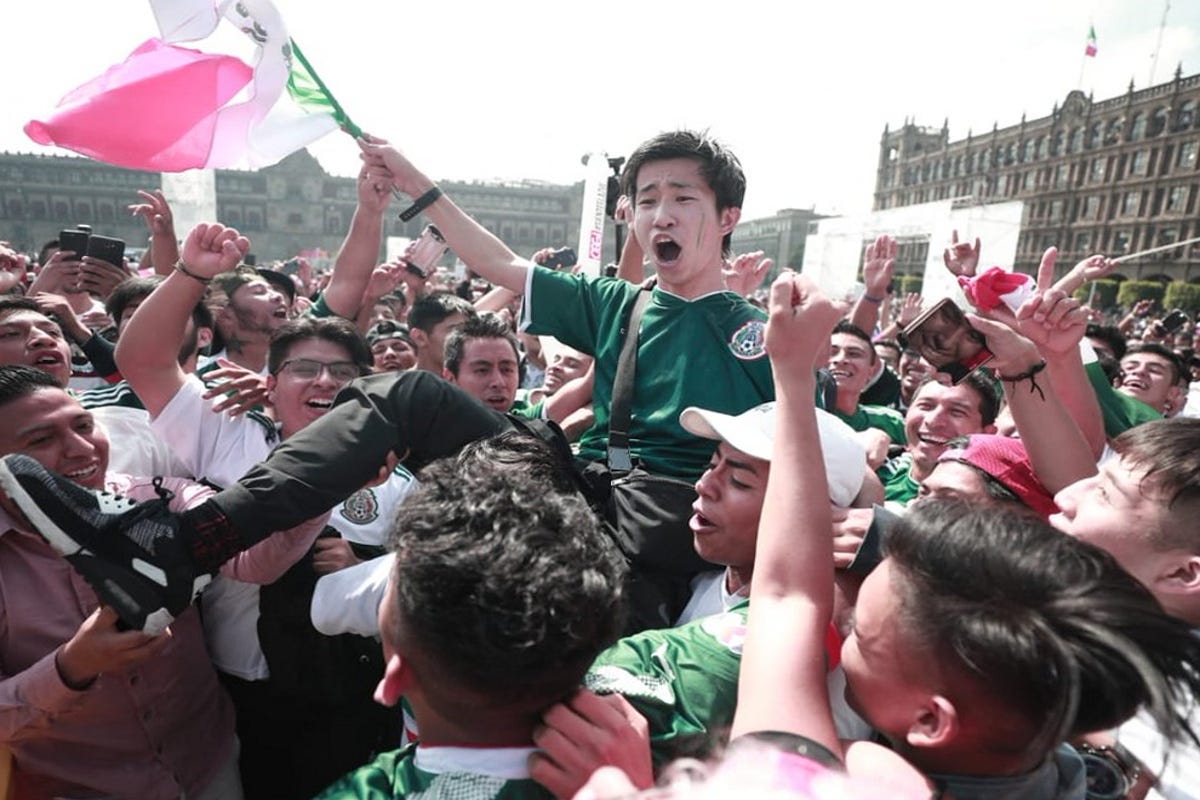
The silver lining of Germany getting knocked out by South Korea, letting Mexico advance out of the group was the viral clips of Mexican fans outside the Korean embassy in Mexico City, chanting:
“Koreano, hermano, ya eres Mexicano.” (Korean brother, you’re Mexican now).
For a brilliant moment all of my Instagram and Reddit feeds were full of Mexican fans jubilantly proclaiming that “South Korea is officially invited to the Carne Asada.”
The game feels beautiful again.
I’m there to see it all—with my friends and the woman I love, hungover but fully awake for the day in front of me. As Alexis and I drive home from Santa Rosa, the World Cup slides back into the background, and nothing feels like it’s slipping past me.
Coda- 2026- Canada, USA, Mexico
While at the gym with Alexis in 2018 I told her that in eight years the World Cup would be hosted in the US. Finally, we wouldn’t have to wake up at strange hours or watch alone. Our friends could even go to games together.
“2026? How old will I be then?”
“Thirty two,” I said.
“Oh I’m definitely going to be pregnant,” she said, then, jokingly: “You can’t hang out with your friends, I’m PREGNANT.”
Like clockwork, many of her female friends have recently “pulled the goalie” in preparation for trying to have kids. But we aren’t there yet. We’re trying to hold that truth graciously and compassionately in a society where fertility anxiety is now as contagious and charged as COVID once was. The gendered aspect of this has been hard to ignore. While many of my friends are debating the merits of watching games at Levi’s Stadium vs Estadio Azteca, many of hers are discussing prenatal vitamins and the insights gleaned from their Oura rings.
The World Cup remains the only thing in my life that arrives exactly on schedule, every four years without fail. For a few weeks, the world reorganizes itself around a shared obsession. Everyone shows up, loudly and earnestly, willing to suspend disbelief and care too much. It’s the closest most of us get to feeling like citizens of the world. For a brief, glorious stretch, we all become woo girls.
This summer I know I’ll be watching—maybe in a stadium, maybe in a bar, maybe on a couch. Some of my friends may be pregnant. Some may be struggling to get pregnant. Some will have reorganized their lives around new axes—chosen ones like parenthood or partnership, and those imposed by illness or loss. Others will be living familiar lives on purpose, just with cozier furniture and fewer illusions. We’ll all be watching the same games, but from very different distances.
I’m excited to be there—not to chase a feeling, or escape my life, but to see what’s been preserved, what’s been replaced, and what still draws us together.