Stranger Than Fiction
Netflix's Stranger Things is what happens when a great story gets devoured by spectacle and fan service

The following contains spoilers for Stranger Things
Chapter 1- The Diagnosis
I almost escaped.
And then, somehow, I was back inside the Upside Down, confused about what was going on.
It all started a decade ago when I started this mysterious new show.
At the core of the first season were three tense narratives running in parallel: kids on a coming-of-age adventure, teens in a slasher movie, and adults trapped in a paranoid conspiracy thriller. Each strand worked on its own, and made the others richer as they converged. I was propelled forward through curiosity, not exposition dumps. The stakes escalated naturally because I liked the characters and their choices mattered. The world evocatively framed the ’80s as a place where suburban comfort masked deeper rot and children were left to confront dangers adults refused to name.
I didn’t just binge it; I believed in it.
Over time, the show pivoted from sci-fi mystery toward action adventure, expanding the scale and delighting some viewers while alienating others. By the time I finished the last season, my main feeling wasn’t sadness, catharsis, or clarity; it was relief. Not because the show was terrible, but because it had become much harder to love, bloated, cautious, and overwhelmed by its own success.
Stranger Things doesn’t fail because it runs out of ideas. It underwhelms because it became too popular to be brave.
Chapter 2: The Gang’s All Here
Every season of this show adds more characters. Some, like Season 2’s Max and Season 3’s Robin were welcome additions. By Season 5, it’s unwieldy. What once felt like a tight ensemble is now a crowded group chat with everyone talking over each other.
The tipping point was in season 4 when new adults and subplots about Russian gulags and shadowy government agencies added runtime not depth. Season 5 doubled down on this sprawl by centering Holly Wheeler as yet another protagonist. This felt as natural as her Little Red Riding Hood costume design.
Juggling this many characters means our favorites get lost and many arcs are underbaked or abandoned. Dustin and Steve evolve, but Jonathan and Mike stand around coasting on things they said or did seasons ago. Core characters like Hopper and Eleven end up feeling like guests in their own show. Nancy becoming Rambo may be absurd, but it’s at least growth. Lucas, by contrast, spends the final season just waiting for Max to wake up.
Chapter 3: The Pacing
Season 4 embraced indulgent, movie-length episodes, hopping between far-flung locations in a sequence of meandering tangents. Hopper’s Russian prison subplot could have been condensed—or cut entirely—and the season would have lost nothing. The reveal about Vecna’s past is one of the best moments in the show but arrives late and feels disconnected from Hopper sword-fighting a demogorgon in Kamchatka.
In Season 5, the pacing problem shifts. Characters repeatedly pause for heart-to-heart conversations in the middle of time-sensitive situations, draining scenes of realism and deflating tension. The result is a pacing civil war, where moments of suspense are consistently undercut by obligatory emotional check-ins. Fans will cite Season 3’s “NeverEnding Story” duet as precedent, but what once worked as a brief, earned aside becomes, by Season 5, the story’s default mode.
The later seasons of Stranger Things increasingly keep characters in multi-episode holding patterns, turning progress into delays and tension into stalling. Hopper escapes prison only to be recaptured. Max and Holly escape Vecna’s grasp only to be returned to it. Instead of building toward release, episodes keep resetting everything, trapping characters and viewers in a cycle of motion without arrival, as if United Airlines were running the show.
Chapter 4: The Stakes
Shows like Breaking Bad work because they obey narrative physics: every choice permanently alters the story. Stranger Things refuses to close doors, so characters’ actions have no consequences. Hopper’s sacrifice at the end of Season 3, is undone by his resurrection in Season 4. Season 4 ends with Vecna opening a massive portal, setting up a terrifying invasion of Hawkins. Season 5 covers it with sheet metal and narration and moves on. Death and danger once meant something in this show. Now the story repeatedly asks us to invest in stakes it refuses to honor. As The White Lotus demonstrated in its third season, avoiding irreversible choices doesn’t create suspense; it produces stories that are busy but tedious.
Adding to the weightlessness of the final season is the refusal to harm core characters. Earlier seasons understood the power of loss. Barb’s death in Season 1, Bob’s in Season 2, Billy’s in Season 3, and Eddie’s in Season 4 all mattered. They left scars on the characters who survived and gave weight to the conflict.
In Season 5 you can immediately sense that no one you truly care about is going to die. While it’s satisfying to see the entire ensemble graduate from high school, the absence of loss drains the moment of meaning. Eleven’s implied death gestures at loss without demanding it—a farewell to childhood wonder that leaves the characters largely untouched.
We end instead on a poignant but saccharine Toy Story 3 echo: the gang tearfully shelves their D&D binders and passes the basement to the next generation. Everyone gets a happily ever after, but we’re never shown how the trauma these kids endured shaped them into adults. Had Max died, Lucas placing his binder beside hers would have landed like a gut punch.
The Duffer Brothers consistently choose comfort over consequences. Ending their coming-of-age story with a return to cozy suburban equilibrium delivers closure, not growth.
Chapter 4: The Battle of Spectacle vs Story
Stranger Things’s biggest problem is that the complicated sci-fi action plot ends up eclipsing the coming-of-age story underneath it.
Season 5 suffers from clunky dialogue optimized for “second-screen viewing,” the modern studio mandate that shows are written so viewers scrolling on their phones can still follow the plot. Characters describe what they’re doing, recap what just happened, and rehash their plans with a level of specificity that makes Christopher Nolan dialogue look subtle by comparison. While shows like Mad Men or The Wire won accolades for trusting the audience to digest the subtext, shows like Stranger Things don’t trust their audiences to watch them.
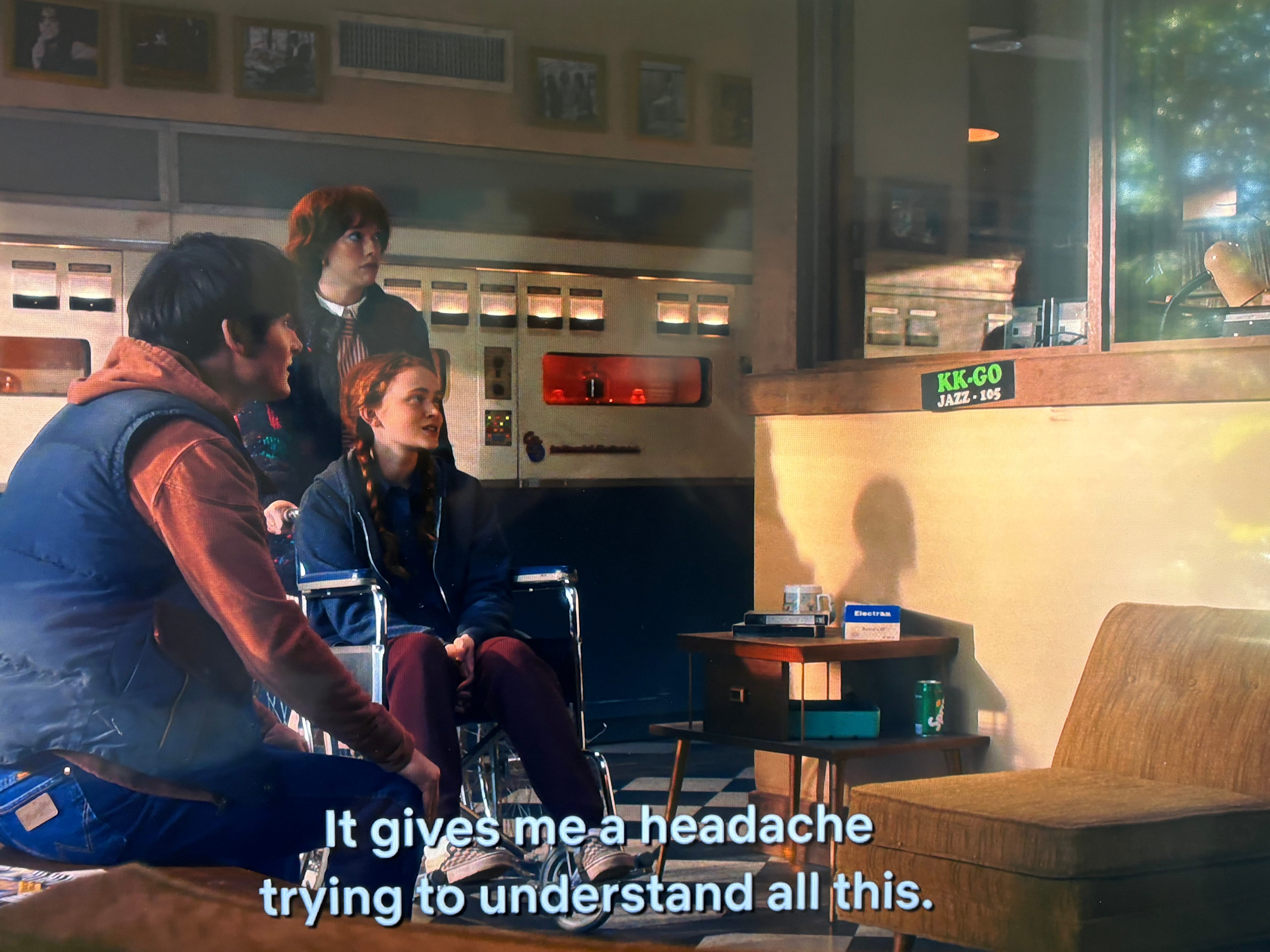
That must be why every new plan and plot development comes with a “lightbulb moment” of the cast explaining it out loud with visual aids borrowed from their immediate surroundings. Huge chunks of runtime consist of characters summarizing the plot to one another, as if no one in the room—or on the couch—can keep track of what’s going on.
Further taking you out of the world is ironically the enormous budget dedicated to rendering it. Demogorgons, once terrifying monsters as infrequently seen as Jaws are now omnipresent, copy-pasted bullet sponges. The Upside Down, once menacing, tactile, and gross, now feels like another dimly lit, oddly empty backdrop for a tension-less CGI brawl. As a result, the final episode feels like the third act of an Avengers movie mashed up with an episode of Power Rangers.
Chapter 5- Linda Hamilton
Why is 80s icon Linda Hamilton even here? What is her motivation? To fight the Russians? Research the Upside Down? Reassert government control? The show doesn’t seem to know either. After carpooling home from killing Vecna and the Mind Flayer, the kids are apprehended by her, then promptly released—despite killing dozens of soldiers in earlier episodes. If consequences no longer apply, why include a character whose entire role is to wave a gun at them?
A better use of her character would be having her turn and help distract the demogorgons and bats (where did they all go?) while our squad kills Vecna befor e recruiting Nancy as a super-assassin given her newfound aptitude with firearms.
Chapter 6: The Vanishing of the Humanity
What made Stranger Things work was never the monsters or the wormholes. These only mattered because they threatened people we understood and cared about.
What got lost amid the dozens of helicopters, Humvees, and heists so complicated they made me pine for Inception was the humanity. As the scale grew, the emotional signal weakened. When key emotional beats arrive, they land with the subtlety of a Molotov cocktail. Instead of trusting subtext or performance, the show opts for indulgence and explanation.
This is why so many people had issues with Will’s coming-out scene. Having him come out in a conference room full of nearly every major character, right before the final showdown feels more like a narrative obligation than a genuine human moment.
A better show would have trusted us to infer Will’s identity after his epic sorcerer moment—or found humor in letting him be repeatedly interrupted while coming out to his core friends, reinforcing that it isn’t a dramatic twist, just part of who he is.
Aspiring screenwriters should study this show for its propulsive, character-driven writing and its clunky, awkward sprawl. They’ll learn how the challenge of writing a successful series changes over time, as success itself begins to distort the work—forcing a tight, self-contained story to expand past its natural limits and buckle under the weight of fan expectations.
Chapter 7- The Internet and the Upside Down
Stranger Things arrived just as streaming and social media peaked, fusing both into a continuous feedback loop. Over time, the world outside the show began collapsing in on the story itself. Sometimes this was obvious, like the visibly older actors due to the shooting delays caused by COVID and the writers’ strike. Other times this was subtle, like how David Harbour now carries cultural baggage thanks to Lily Allen’s “West End Girl.” I doubt the Duffer Brothers intended for me to start singing “Pussy Palace” every time Hopper walked onscreen, but you can’t unring a bell.
You can feel the unbearable pressure bearing down on the show by the end: from Netflix to justify the budget, from fans to do right by their favorite characters, from the internet hivemind to not mess this up. In being afraid to disappoint anyone, the series loses the confidence to make hard, narrowing choices.
Properly assessing Stranger Things hinges on a distinctly modern dilemma: whether a show belongs to its audience’s expectations or its own narrative logic. Pleasing fans is safer while telling a coherent, consequential story requires the willingness to disappoint them.
Chapter 8- Graduation (Friends Forever)
If all of this sounds harsh, it’s only because the show trained me to expect better. What makes the slip ups so noticeable is remembering how sure-footed the story once was.
Stranger Things isn’t awful; it’s almost great.
It’s a heartfelt story about the power of friends and family. The way Vecna embodied trauma was interesting, disturbing, and moving. Max running up that hill (the first time) and dying in Lucas’s arms (kind of) was genuinely moving to watch. The 80’s needle drops were pitch-perfect and epic.
Even the cheesy fan-service stuff was as satisfying as a piping hot Eggo waffle. I loved Nancy becoming the trigger-happy Annie Oakley of the group. I cheered out loud when they teamed up to take down the Mind Flayer, even if the backdrop looked like a Linkin Park music video.
But after 45 minutes of endings that made The Return of the King look mercifully concise, I didn’t feel sad or triumphant. I felt oddly blank. There was no ambiguity to sit with or loss to mourn, just a cozy finality telling me and the kids leaving the basement, “well, I guess it’s time to stop goofing off and go eat dinner now.”
The sadness came later. I’m sad that it’s over, sad that it felt underwhelming, and sad that a story that once united us is now as polarizing as everything else.
Growing up is hard, even if you’re a beloved TV show.